
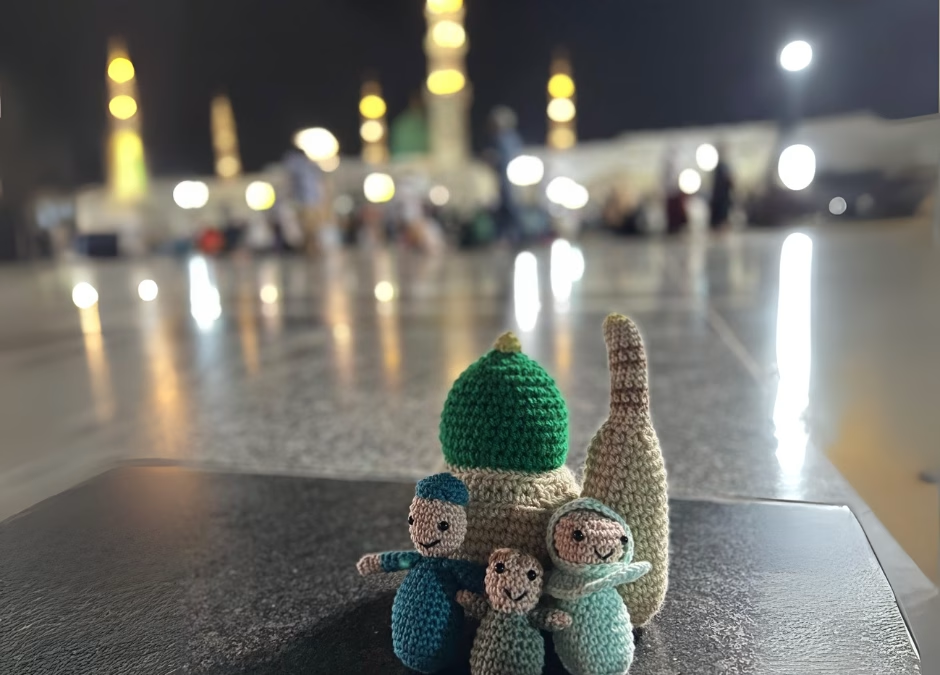
There are some journeys that change your scenery—and others that change yourself. Ziyārah is the latter.
It’s hard to put into words what happens when you stand before the resting places of those whose lives rewrote the meaning of love, sacrifice, and resilience. From my son’s first birthday to his second, I had the extraordinary privilege of undertaking the Ziyārah of the 14 Maʿṣūmīn (ʿa). As a mother, a therapist, and a seeker, the journey became more than just a physical pilgrimage—it was a deep unraveling and reweaving of the soul. Each sacred site was not just a destination; it was a meeting place—between my grief and grace, my prayers and pain, my doubts and devotion.
But there was a quieter, more tender healing I hadn’t anticipated: the transformation that unfolded in witnessing my toddler accompany us on this sacred journey.
In the courtyards of the ḥaram, while I sat reciting duʿāʾ with tears on my face, my son played nearby—chasing pigeons, watching people, gently reaching for the ḍarīḥ with wonder. Despite the intensity of travel, the crowds, and the logistics of parenting in unfamiliar spaces, a deep and unshakable peace settled over us. The chaos of daily parenting didn’t disappear—but it no longer created anxiety. There was something about the spiritual container of Ziyārah that softened everything. There were no alarms going off in my nervous system, just calm.

Ziyārah, with all its sacred weight, somehow made space for childhood.
It made space for giggles and for grief, for tears and toddler snacks, for quiet duʿās and diaper bags. And in that integration, I saw something I hope to never forget: this is how we teach emotional expression—by living it. My child saw his parents cry openly, pray vulnerably, and fall silent in awe. He witnessed emotional honesty in a sacred space, and that is its own healing inheritance.
Ziyārah – More Than a Visit
Ziyārah (زِيارَة) means “visit,” but in our tradition, it’s so much more than a trip to a grave. As described in Kāmil az-Ziyārāt, it’s a living encounter—a slowing down, a sacred stepping into presence, and a communion with the eternal souls of the Ahlul Bayt (ʿa). In visiting them, we do not simply honor the past—we meet those who live on in truth, love, and Divine connection.
“When you visit the grave of Imām Ḥusayn (ʿa), know that he hears your words and responds to your greeting.”
As a psychotherapist, I view Ziyārah not only as an act of devotion but as a form of relational healing—one that nurtures three core relationships: with the self, with others, and with the sacred.

Relationship with the Self
Ziyārah creates a reflective space—one where we slow down, listen inwardly, and meet ourselves with greater honesty and compassion. The silence of the ḥaram (sacred shrine) is not empty—it’s filled with the whispers of your own soul.
Many clients describe moments of self-discovery, emotional catharsis, or a shift in perspective they hadn’t accessed in therapy alone. Whether it’s weeping before the grave of Imām Ḥusayn (ʿa), or journaling near the resting place of Imām al-Kāẓim (ʿa), the act of showing up—dusty, tired, emotionally raw—is itself a gesture of self-love and courage.
“Every aggrieved, distressed, sinful, saddened… person who goes to his Ziyārah… will have his grief removed and Allah will fulfill his needs.”
— Imām al-Bāqir (ʿa)
Relationship with Others
Ziyārah is never done in isolation. Even when walking alone, you’re surrounded by seekers—each carrying grief, love, longing. This shared vulnerability builds a sacred sense of belonging.
When I traveled with my husband, I witnessed how Ziyārah became a relationship reset. Watching each other in prayer, holding space for each other’s pain, witnessing tears fall—these moments cultivated an intimacy words often fail to reach. For couples, it can repair emotional distance, restore tenderness, and rebuild spiritual alignment.
“The believer who visits Imām ʿAlī ibn Husayn (ʿa), Allah will illuminate his heart, strengthen his spirit, and lift the burden from his soul.”
Relationship with the Sacred
The spiritual heart is often sidelined in mental health conversations. But for many Muslims, healing is incomplete without Divine connection. Ziyārah restores that connection—not through abstract theology, but in the felt presence of being seen, heard, and loved by the Divine.
“There is a contract upon every Shīʿah towards his Imām, and the most perfect way to fulfill it is by performing his Ziyārah… On the Day of Judgment, the Imām will intercede for one who performs his Ziyārah with longing…”
— Imām ar-Riḍā (ʿa)
The impact? A heart less burdened by guilt and a spirit softened by grace. A soul that is reminded that it is not alone.

Ziyārah as Therapy: A Complement, Not a Replacement
When clients mention plans for Ziyārah, I don’t just hear it as a religious ritual—I see it as a spiritual intervention. A relational repair. A sacred trauma-informed healing process.
Therapy gives us language for our wounds. Ziyārah gives those wounds a place to rest.
These two pathways aren’t competing—they’re deeply complementary. Just as medication and meditation can work together, so too can therapy and sacred pilgrimage.
Tips for Emotional and Mental Well-being During Ziyārah
- Set an Intention: What do I seek to leave behind? What do I hope to receive?
- Allow Yourself to Feel: Grief, love, joy—all belong. Let the tears fall.
- Journal the Journey: Even one line a day can become a window back to this sacred time.
- Walk Barefoot, Literally or Figuratively: Approach with humility. Dust-covered, disheveled, just like Imām aṣ-Ṣādiq (ʿa) described.
- Practice Gratitude: You were invited. That alone is proof of Divine love.
- Seek Support if Needed: Combine spiritual care with therapeutic support when needed.

When the Journey Continues After You Return
- Let your duʿās evolve into daily presence.
- Let your tears become prayers you whisper on hard days.
- Let your presence at the shrine shape your presence with loved ones.
- Reach out to the Imāms (ʿa) in your struggles—they are still listening.
- Continue spiritual practices as a family, couple, or individual.
Ziyārah is not a vacation—it’s a pilgrimage of the soul. Your feet may blister, your back may ache. But somehow, none of it disrupts the profound peace of being exactly where your soul needed to be.
If you’re going soon—go with your whole heart.
If you’ve just returned—may the journey continue inward.
And if you haven’t yet been—may you feel the Imām’s invitation stirring quietly within you.
And may you, like so many before you, return not just with souvenirs and photos—but with a softened heart, a clearer purpose, and a soul gently realigned with the One who never left you.
Tears that Build Chambers: ʿAzāʾ, Communal Mourning, and the Grief the Clinic Forgot How to Honor
Introduction: The Grief That Will Not Be Scheduled It is two in the morning, three years after the funeral, and you are crying again. And somewhere beneath the grief is a second, more corrosive feeling: the suspicion that something is wrong with you for still grieving...
Muwāsāt: The Therapy of Being-With — Presence, Co-Regulation, and the Night of ʿĀshūrāʾ
Introduction: When There Is Nothing to Fix There is a particular hour that brings people to my consulting room, even when they arrive at it during the day. It is the hour, often around two in the morning, when a person sits on the floor of a bathroom or at the edge of...

Rebuilding What Cannot Be Rebuilt: Post-Traumatic Growth and the Community of Remembrance
Part 3 of 3 | The Graves They Could Not Bury: Islamic Psychology of Sacred Grief on Yawmul Ghamm Introduction: Can a Community Grow from a Wound That Remains Open? In the first post of this series, I named the grief: disenfranchised, morally injurious, and ongoing....