
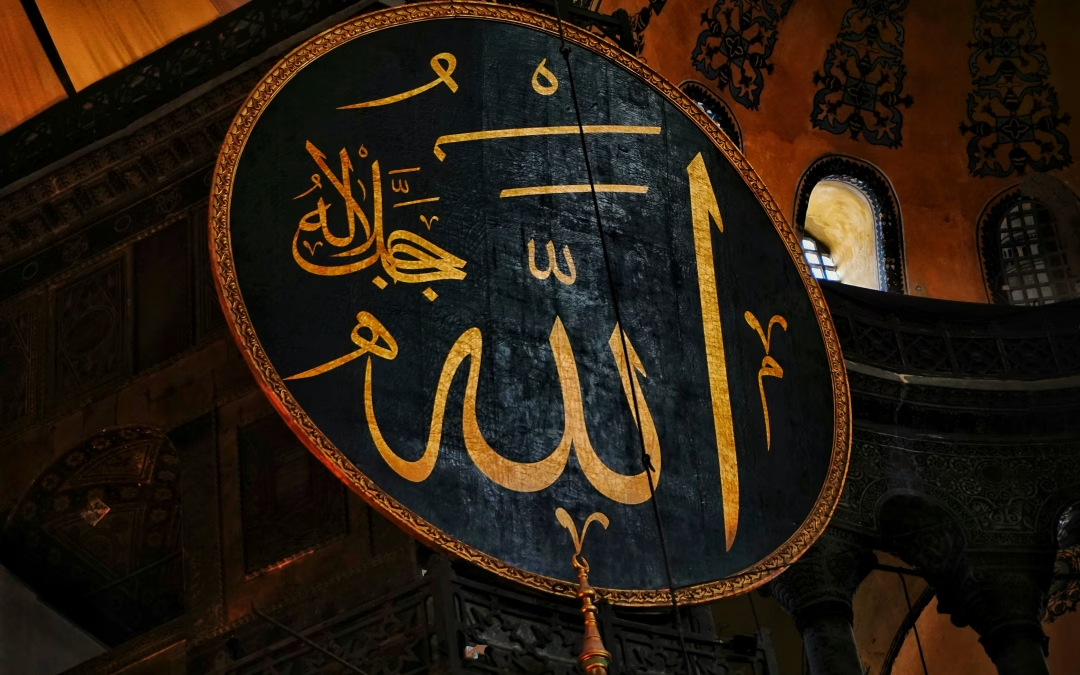
One evening, after an exhausting and anxiety-ridden couple of weeks of university finals, I unlocked my phone and saw my daily Qur’ān reminder:
“And whoever relies upon Allah, He alone is sufficient for them.” (65:3)
It struck me like a lifeline. Until that moment, I hadn’t realized that the heaviness I was carrying wasn’t just from the events of the week, instead it was from my deep need to control them. I had forgotten Tawakkul: the beautiful surrender of doing my best and trusting Allāh with the rest.
That night, I prayed differently. I wasn’t asking for control; instead, I was letting go. And for the first time in days, I slept peacefully.
Like me, many of us wrestle with anxiety when life feels uncertain. But as Muslims, we are reminded that true peace comes from balancing effort with trust in Allāh. This balance, Tawakkul, is our anchor in the storm.

Tawakkul: A Misunderstood Strength
Tawakkul is often mistaken for passivity, but in Islām, it’s the opposite. It means striving with all our might, then trusting that Allāh (SWT), in His infinite wisdom, will take care of the outcome. The Prophet Muḥammad (PBUH) lived this balance. Even during the Hijrah, the most critical journey of his life he planned carefully, sought help, took precautions, and yet fully relied on Allāh (SWT).
Tawakkul, then, is not the absence of fear or anxiety. It’s choosing faith alongside it.
The Three Pillars of Tawakkul
To truly embrace Tawakkul, we need to understand its key components:
- Taking Action: Islām urges us to seek solutions, strive, and do our part.
- Trusting in Allah’s Plan: Understanding that Allāh (SWT)’s wisdom encompasses our limited view.
- Letting Go of Excessive Worry: Realizing that anxiety doesn’t change the future.
When Faith Meets Psychology
From a psychological perspective, anxiety is our body’s natural response to perceived threats. It triggers physical changes like rapid heartbeat and tense muscles to help us “solve” problems, even if they’re imagined. Common triggers include fear of failure, trauma, loss, perfectionism, or a need for control. But feeling anxious doesn’t mean you’re weak in faith. It means you’re human. Even the prophets experienced fear, but what set them apart was how they responded: with faith, patience, and surrender.

Tawakkul and Mental Wellness
Therapy and coping tools aren’t separate from Islām – they can actually support our Tawakkul. While therapy helps us manage thoughts and emotions, Tawakkul anchors our mindset. It reminds us that we are not alone in our struggles. Allāh (SWT) is Al-Ḥakīm (The All-Wise), Al Razzāq (The Sustainer), and Al-Wakīl (The Trustee).
When we embrace Tawakkul, we free ourselves from the burden of overthinking. We make room in our hearts for stillness, prayer, and patience. We remember that the One in control loves us more than we can imagine. And that is the greatest relief of all. Surrendering to Allāh (SWT) doesn’t mean giving up. It means choosing peace over panic, faith over fear. And in that surrender, we find strength, resilience, and the quiet power of trust.
When we think of Tawakkul, we often picture a spiritual state one of placing trust in Allāh (SWT) after doing our part. But what’s beautiful is that this act of surrender also impacts us on a physiological level. In fact, neuropsychology shows us how deeply intertwined the mind and body are when it comes to stress, anxiety, and ultimately faith.
Anxiety begins in the brain. When we perceive a threat, real or imagined, our amygdala (the brain’s fear center) activates the fight-or-flight response. Cortisol and adrenaline flood our body. Our heart races. Our muscles tense. And our mind starts running in loops trying to “solve” a problem. This is helpful in short bursts but harmful when constant.
Here’s where Tawakkul comes in, not just as a spiritual concept, but a neurological intervention. When we remind ourselves “Allāh (SWT) is sufficient for me” or breathe deeply while making du’ā, we signal to the nervous system that we are safe. Studies show that belief, prayer, and meditation like practices regulate the amygdala, lower cortisol, and engage the parasympathetic nervous system—the body’s rest-and-repair mode. In simpler words, Tawakkul calms the brain.
Surrendering to Allāh (SWT) doesn’t mean giving up, it means acknowledging that control is limited, and that true peace lies in alignment with divine wisdom. Neuropsychologically, letting go of control quiets the prefrontal cortex, reduces decision fatigue, and decreases overthinking.
Even dhikr, the remembrance of Allah and acknowledgement of his greatness; has shown effects similar to mindfulness and deep-breathing techniques used in modern therapy. You’re not just remembering God; you’re soothing your nervous system, training your brain to find refuge in trust instead of fear.
So, when we say Tawakkul, we’re not just engaging our soul we’re also reshaping the way our brain processes uncertainty. And maybe that’s where the miracle lies: Islām doesn’t ask us to reject our humanity. It teaches us how to navigate it with both heart and mind anchored in Allāh (SWT).

Common Misconceptions to Avoid
“If I had more Tawakkul, I wouldn’t feel anxious.”
In reality, even the most devout believers experience moments of anxiety. Tawakkul is not the denial of your worries it’s the mindful response to them. It teaches us how to work with our anxiety rather than pretend it doesn’t exist.
“Having ṣabr means I have to keep everything bottled up.”
True patience isn’t about suppression; it’s about knowing when to reach out for support, setting healthy boundaries, and acting in ways that honor your well-being. Even the Prophet (SAW) sought help during challenging times.
Practical Ways to Build Tawakkul While Coping with Anxiety
- Journal Your Worries: Write down your concerns and then make Du’ā as a way of symbolically handing them over to Allāh (SWT).
- List Your Controls: Identify what is within your control and accept what isn’t, releasing that which you cannot manage through prayer.
- Use Qur’ānic Affirmations:
– “Hasbin Allāhu wa ni’mal wakīl” – “Sufficient for us is Allah and (He is) the best disposer of affairs.” (Qur’ān 3:173)
– “Inna ma’iya Rabbī sayahdīn” – “Indeed, my Lord is with me; He will guide me through” (Qur’ān 26:62).
– “Innī limā anzalta ilayya min khairi faqīr” – “My lord, I am in need of whatever good you send down to me” (Qur’ān 28:24)
- Start Your Day with a Du’ā: Embrace a morning supplication that focuses on protection and trust, setting a tone of peace and reliance for the day ahead.
In conclusion, experiencing anxiety does not signify a failure of faith it reflects the trials of life. Islām equips us with spiritual resilience to face these challenges with courage, calm, and a deep connection to Allāh (SWT). Tawakkul isn’t about eliminating worry; it’s about recognizing who to turn to in moments of doubt. When you combine that trust with compassionate mental health practices, you’re not merely surviving – you’re on a path to healing.

Tears that Build Chambers: ʿAzāʾ, Communal Mourning, and the Grief the Clinic Forgot How to Honor
Introduction: The Grief That Will Not Be Scheduled It is two in the morning, three years after the funeral, and you are crying again. And somewhere beneath the grief is a second, more corrosive feeling: the suspicion that something is wrong with you for still grieving...
Muwāsāt: The Therapy of Being-With — Presence, Co-Regulation, and the Night of ʿĀshūrāʾ
Introduction: When There Is Nothing to Fix There is a particular hour that brings people to my consulting room, even when they arrive at it during the day. It is the hour, often around two in the morning, when a person sits on the floor of a bathroom or at the edge of...

Rebuilding What Cannot Be Rebuilt: Post-Traumatic Growth and the Community of Remembrance
Part 3 of 3 | The Graves They Could Not Bury: Islamic Psychology of Sacred Grief on Yawmul Ghamm Introduction: Can a Community Grow from a Wound That Remains Open? In the first post of this series, I named the grief: disenfranchised, morally injurious, and ongoing....