
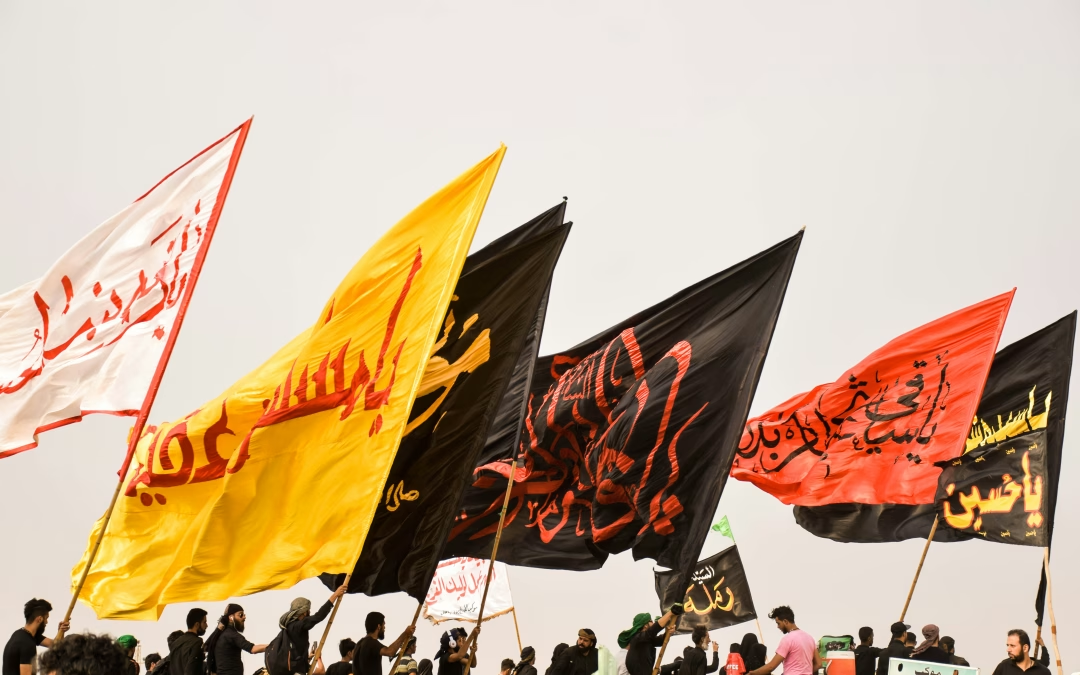
Every year, millions of people reach the land of Karbala to pay their respects to Imam Hussain (a), following in the footsteps of his sister, Sayyidah Zaynab (s), and his son, Imam Zainul Abideen (a). Many partake in the journey of love that begins in the city of Najaf, where mourners give condolences to Imam Ali (a), and commence their walk toward Karbala—a journey spanning 2 to 5 days on foot. Some pilgrims begin even farther, from cities like Basra or Baghdad. Known as the largest peaceful gathering in the world, the number of participants increases every year. But this is not just a peaceful march, it is a journey of community, belonging, and devotion.
The Community
In recent years, many influencers and newcomers have been moved by what they witness during `Arba’īn: families opening their homes, people begging to serve food and water, volunteers offering free medical care, and children handing out gifts and sweets. For many, this is an overwhelming display of generosity. But for those familiar with the love of majlis, or with the concept of fanaa (annihilating the self for the sake of God’s path) this is a familiar and cherished way of life.
In the months of azā` (mourning), serving guests is not just a noble act, but also a spiritual duty. These guests are believed to be the guests of Abā ‘Abdillāh, Imām Husayn (a). With this intention, acts of service are no longer transactional. There is no expectation of recognition or reciprocation—not even from Allāh (swt). The reward is the act itself. Love manifests in the simplest of gestures: a bowl of soup, a bottle of water, a place to rest one’s feet.
This deep sense of community is not limited to `Arba’īn. Islamic practices are inherently communal. The daily prayers in jamāt (congregation) foster connection, equality, and mutual responsibility. When Muslims fast together in Ramadan, break bread together, and pray through the night, they strengthen bonds beyond blood and nation. The majlis gatherings to mourn Imām Husayn (a) throughout Muḥarram bring people together in shared grief and purpose.
This kind of community resonates with several communal perspectives, such as the Indigenous African concept of Ubuntu which means “I am because we are.” It affirms that personal identity and fulfillment arise from collective responsibility and care. On the road to Karbalā`, such principles are not taught through lectures—they are embodied in the acts of the zā`irīn.

Belonging
To be in Karbalā` during `Arba’īn is to belong. No matter where you’re from, what language you speak, or what status you hold—everyone walks with the same purpose. Everyone is crying for the same Imam. That shared intention dissolves difference and builds deep, immediate bonds.
In psychology, belonging is one of the most basic human needs, tied to mental well-being, self-worth, and resilience. Islam addresses this need holistically. The idea of a spiritual nation creates a sense of belonging that is not bound by geography but by values, love, and shared rituals.
In the story of Karbalā`, people find not just inspiration, but a profound emotional anchor. The different ages of the martyrs, the relationships and the connections we hear about are all ways of connecting with the story of Karbalā` and feeling a sense of belonging. Furthermore, there is a strong connection to the Ahlul Bayt (a) where one can feel like they belong no matter where they are from or how old they are.
Devotion
When embarking on the Ziyārat (visit) to Karbalā`, especially during `Arba’īn, something transcends the mundane experience of everyday life. Pilgrims are placed through discomfort, exhaustion, and sometimes even suffering. This is not a vacation; it is a conscious decision to embrace hardship in the hope of feeling even a fraction of the pain endured by Imām Husayn (a) and his companions. There is honor in this. Devotion, in this sense, is a form of enthusiastic love and loyalty to a cause that is both spiritual and personal. It means walking towards Karbalā` not out of duty, but because you want to be part of the greater mission.
In Shī’ā Islam, the concept of devotion is deeply rooted in the idea of Imām Husayn’s sacrifice as a model for personal transformation. His devotion to values such as truth, justice, and righteousness is seen as an ultimate example for all believers. It is the act of giving everything for the sake of Allāh but also being content with whatever Allāh plans for you as the All-Wise and All-Merciful. This is not just a theological concept but something that is embodied in the journey to Karbalā`. It is the same devotion that leads individuals to give their time, energy, and resources without expecting anything in return.

Conclusion
The Ziyarat of `Arba’īn is not simply a walk—it is a movement of the heart. It is an opportunity to reform the self, to peel away distraction and ego, and to realign with divine values. It is a place to feel, to grieve, to give, and to grow. In walking toward Husayn (a), we walk toward truth, justice, and love.
More than anything, `Arba’īn is an invitation to be part of something greater than ourselves. It is a reminder that even in our brokenness, we are still connected—to a history, a mission, and a living legacy.
Reflection Question for Ziyārah:
As you walk, reflect: What in this journey has brought you closer to Allāh—and closer to your true self? What part of your soul will you leave at the feet of Husayn? And what part will you take home with you?
Tears that Build Chambers: ʿAzāʾ, Communal Mourning, and the Grief the Clinic Forgot How to Honor
Introduction: The Grief That Will Not Be Scheduled It is two in the morning, three years after the funeral, and you are crying again. And somewhere beneath the grief is a second, more corrosive feeling: the suspicion that something is wrong with you for still grieving...

Rebuilding What Cannot Be Rebuilt: Post-Traumatic Growth and the Community of Remembrance
Part 3 of 3 | The Graves They Could Not Bury: Islamic Psychology of Sacred Grief on Yawmul Ghamm Introduction: Can a Community Grow from a Wound That Remains Open? In the first post of this series, I named the grief: disenfranchised, morally injurious, and ongoing....
When You Cannot Visit: The Psychology and Spirituality of Mourning from Afar
Introduction: The Grief That Distance Carries In the first post of this series, I explored the psychological architecture of sacred grief: how the destruction of Jannatul Baqīʿ in 1925 produced a wound that Western clinical models struggle to name, let alone hold. I...