
Introduction: A Grief That Clinical Textbooks Do Not Name
At Kisa Therapy Clinic, we encounter a form of grief that most clinical textbooks do not name. It is not the grief of losing a loved one to illness or accident. It is not the grief of a sudden death or an anticipated decline. It is something older, deeper, and more structurally complex: the grief of a community whose sacred dead were desecrated, whose burial grounds were demolished, and whose mourning itself has been treated as deviance.
Every year on 8 Shawwāl, Shīʿah Muslims around the world observe Yawmul Ghamm (يَوْمُ الْغَمّ, Day of Sorrow), marking the anniversary of the destruction of Jannatul Baqīʿ, the sacred cemetery in Medina where four of the twelve Imāms (ʿa) are buried. This is not a single grief. It is the convergence of three distinct layers of suffering: (1) grief for the Maʿṣūmīn (ʿa) themselves, the Immaculate Guides whose physical resting places were violated; (2) grief for the desecration of sacred space, for the demolition of structures that held centuries of devotion, architecture, and meaning; and (3) the ongoing grief of being denied physical access, of visiting a flat, unmarked field where tombs once stood, and of being told, implicitly and explicitly, that this loss does not matter.
The central argument I make in this post is that this grief is not pathological. It is psychologically legitimate, clinically recognizable, and theologically sacred. I posit that when we apply established clinical frameworks (disenfranchised grief, moral injury, and desecration of the sacred) to the experience of Yawmul Ghamm, we find that Western psychology already possesses the language to validate what the Shīʿah tradition has always known: that grief over injustice to the Ahlul Bayt (ʿa) is not a failure to “move on.” It is a moral, spiritual, and psychological response that the tradition itself sanctifies.
This blog post serves as a diligent attempt to bridge clinical scholarship and theological conviction. Science, in this framing, provides mechanistic language; theology provides foundational authority. Neither is reducible to the other.
How This Post Is Structured
This post moves through four modules. First, I provide the historical context of the destruction of Jannatul Baqīʿ. Second, I apply Kenneth Doka’s framework of disenfranchised grief to name the social dimension of this loss. Third, I turn to the concept of moral injury to name the spiritual wound. Fourth, I examine the ongoing nature of this grief, the fact that the wound remains open, and offer clinical implications for practitioners working with Shīʿah clients. A references section follows at the end.
8 Shawwāl 1344 AH: The Day the Graves Were Destroyed
To understand the grief of Yawmul Ghamm, one must first understand what was lost.
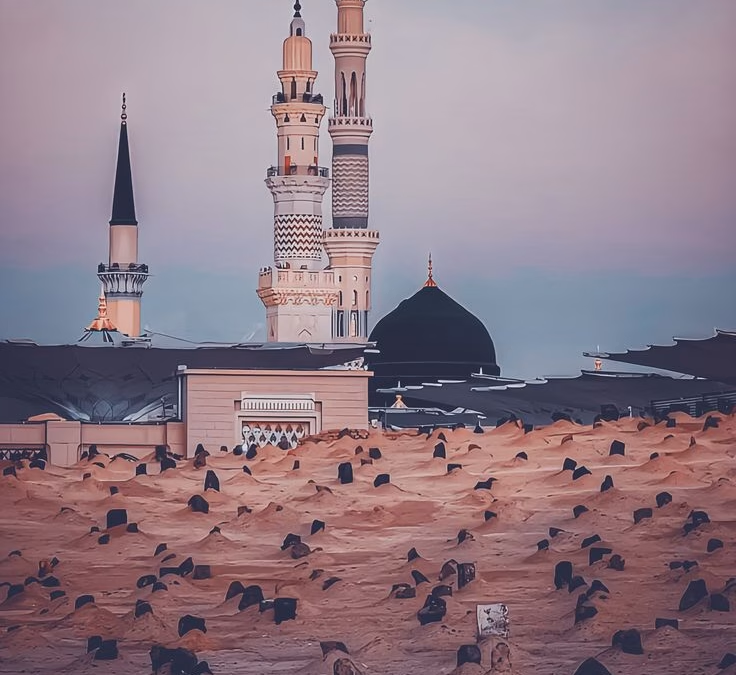
Jannatul Baqīʿ (Garden of Baqīʿ) is the main cemetery of Medina, located adjacent to the Masjid an-Nabawī (the Prophet’s Mosque). For over a millennium, it served as the burial ground for members of the Prophet Muḥammad’s (ṣ) family, his companions, and generations of scholars and believers. Most significantly for Shīʿah Muslims, Baqīʿ houses the graves of four of the twelve Imāms (ʿa): Imām Ḥasan al-Mujtabā (ʿa), the second Imām; Imām ʿAlī ibn al-Ḥusayn Zaynul ʿĀbidīn (ʿa), the fourth Imām; Imām Muḥammad al-Bāqir (ʿa), the fifth Imām; and Imām Jaʿfar aṣ-Ṣādiq (ʿa), the sixth Imām. The grave of Sayyidah Fāṭimah az-Zahrāʾ (ʿa), the daughter of Prophet Muḥammad (ṣ), is also traditionally believed to be located either in Baqīʿ or within the Masjid an-Nabawī itself.
On 8 Shawwāl 1344 AH (21 April 1925 CE), following the Saudi-Wahhābī consolidation of power over the Ḥijāz, the structures, domes, and markers over the graves of Jannatul Baqīʿ were demolished. This was not the first destruction; a similar demolition had occurred in 1806 under the first Saudi state, and the Ottoman Empire had subsequently rebuilt the structures. The 1925 demolition, however, was final. The structures have never been rebuilt.
The day is known by two names: Yawmul Hadm (يَوْمُ الْهَدْم, Day of Demolition) and Yawmul Ghamm (يَوْمُ الْغَمّ, Day of Sorrow). The first names the act; the second names the response.
Eldon Rutter, a British convert to Islam who visited Medina shortly after the demolition, recorded what he saw:
“All over the cemetery nothing was to be seen but little indefinite mounds of earth and stones, pieces of timber, iron bars, blocks of stone, and a broken rubble of cement and bricks, strewn about.”¹
This description captures what the cemetery became, and, in essential terms, what it remains today. Over a century later, Jannatul Baqīʿ is a flat, unmarked expanse of dirt and gravel. The graves of four Imāms (ʿa) lie beneath the surface with no markers, no domes, no structures of any kind. Visiting hours are severely restricted. Women are barred from entry. Photography is prohibited. Zawār (visiting pilgrims) describe the experience of standing before the graves as an encounter with absence itself: the absence of the structures, the absence of dignity, and the absence of any acknowledgment that what lies beneath the ground matters.
It is this absence, sustained and enforced for over a century, that generates the grief this post attempts to name.

Module 1: When Your Grief Has No Name
Disenfranchised Grief and the Loss of Baqīʿ
In 1989, Kenneth Doka introduced the concept of disenfranchised grief: grief that “is not or cannot be openly acknowledged, publicly mourned, or socially supported” (Doka, 1989). Doka identified three primary categories in which grief becomes disenfranchised: when the relationship is not recognized (society does not validate the griever’s connection to the deceased), when the loss is not recognized (the loss itself is not seen as a legitimate cause for bereavement), and when the griever is not recognized (the individual or community is not granted the social role of “bereaved”).
A decade later, Charles Corr (1999) expanded Doka’s framework by adding two additional categories: when the type of death (or destruction) is not recognized as producing legitimate grief, and when the way of grieving is not recognized or is itself stigmatized.
I argue that the grief of Baqīʿ is doubly disenfranchised. It meets not one or two but all five of these categories. Let me trace each application.
The relationship is not recognized. The bond between Shīʿah Muslims and the Ahlul Bayt (ʿa) is not a casual affinity. It is a doctrinal, spiritual, and existential connection grounded in Qurʾānic mandate (42:23, the Āyah of Mawaddah) and reinforced through centuries of devotional practice. Yet in dominant public discourse, this bond is frequently dismissed as excessive devotion, folk religiosity, or sectarian sentiment. The relationship of a Shīʿah Muslim to Imām Ḥasan al-Mujtabā (ʿa) is not recognized within mainstream bereavement frameworks as a relationship that produces legitimate grief.
The loss is not recognized. The destruction of sacred architecture does not appear in any clinical taxonomy as a form of bereavement. There is no DSM category for the demolition of a cemetery. There is no ICD code for the erasure of heritage. The loss of Baqīʿ is, in conventional clinical terms, invisible.
The griever is not recognized. Shīʿah Muslims constitute a religious minority within the broader Muslim world. The grief of a minority community, particularly one whose mourning practices are themselves a source of controversy, is structurally marginalized. The griever is not granted the social legitimacy of the bereaved.
The way of grieving is not recognized (Corr, 1999). Mātam (mourning rituals), annual commemoration of martyrdom, communal lamentation, and the practice of ziyārah (visiting the graves) are not merely unfamiliar to non-Shīʿah observers; they are actively stigmatized. Corr’s expansion captures this precisely: the mode of mourning itself becomes grounds for disenfranchisement.
The type of loss is not recognized (Corr, 1999). Heritage erasure, sacred site destruction, and the forced disappearance of devotional architecture lack clinical categories entirely. This is not the loss of a person but the loss of a place; not the death of an individual but the demolition of a structure that mediates access to the sacred.
The following table summarizes the application:
| Doka’s and Corr’s Categories | Application to Baqīʿ Grief |
| Relationship not recognized | The bond between Shīʿah Muslims and the Ahlul Bayt (ʿa) is dismissed as excessive devotion or sectarian sentiment |
| Loss not recognized | Destruction of sacred architecture is not classified as bereavement in any clinical taxonomy |
| Griever not recognized | Shīʿah communities are a religious minority whose grief is structurally marginalized |
| Way of grieving not recognized (Corr) | Mātam, annual commemoration, and communal lamentation are actively stigmatized |
| Type of loss not recognized (Corr) | Heritage erasure and sacred site destruction lack clinical categories entirely |
Recent scholarship deepens this analysis. Baker et al. (2021) argue that disenfranchised grief carries a “racial dimension,” noting that power dynamics determine whose grief is legitimized and whose is rendered invisible. I posit that the same dynamic operates along sectarian lines: the grief of a minority Muslim community is disenfranchised not merely by clinical oversight but by geopolitical power structures that determine which narratives of loss receive public recognition.
Cameron (2025) identifies “healing through validation” as a key mechanism in addressing disenfranchised grief, emphasizing the restorative role of social recognition. Based on my limited exploration, I suggest that the annual observance of Yawmul Ghamm serves precisely this function: it creates, within the community, the validation that is denied externally. The majālis (gatherings), the lectures, and the collective remembrance on 8 Shawwāl generate an internal ecology of recognition that compensates, at least in part, for the social disenfranchisement.
Finally, Bibi (2025) documents how the COVID-19 pandemic disrupted Islamic burial rituals for British Muslim communities, producing what she termed “grief interrupted.” Her findings are striking: even temporary disruption of mourning practices caused measurable psychological harm. If temporary disruption during a pandemic produced such effects, it is fair to conclude that the permanent destruction of Jannatul Baqīʿ, and the century-long denial of full access to the graves, represents a far more severe and sustained interruption of grief practices.
Module 2: A Wound to the Moral Universe
Moral Injury and the Desecration of the Sacred
Where disenfranchised grief names the social dimension of this suffering (whose grief is recognized), moral injury names the spiritual dimension (what kind of wound this is). These are complementary, not competing, frameworks. Disenfranchised grief tells us that the world refuses to acknowledge the loss. Moral injury tells us that the loss itself constitutes a transgression against the moral order.
The concept of moral injury was formalized by Litz et al. (2009), who defined it as the psychological consequence of “perpetrating, failing to prevent, bearing witness to, or learning about acts that transgress deeply held moral beliefs and expectations.” Originally developed in the context of military veterans, moral injury has since been applied across a range of populations and contexts. Its defining feature, and what distinguishes it from post-traumatic stress disorder (PTSD), is this: PTSD is fundamentally a fear-based response to threat. Moral injury is a shame, guilt, and existential crisis-based response to the violation of one’s moral code. A person with PTSD asks, “Am I safe?” A person with moral injury asks, “Is the world just?” and “Could I have done something?”
Pargament et al. (2005) introduced a framework that is, I argue, directly applicable to the grief of Baqīʿ: the concept of “desecration of the sacred.” Pargament and colleagues define desecration as occurring when “sacred aspects of life are violated by others,” and they identify it as a distinct form of spiritual suffering that is neither reducible to secular grief nor adequately captured by conventional clinical categories. The demolition of Jannatul Baqīʿ is not metaphorically a desecration of the sacred. It is literally, concretely, and historically a desecration of the sacred. The graves of the Imāms (ʿa), the structures that marked their resting places, the spaces where Zawār performed ziyārah for centuries: all of these were sacred objects, and all of them were violated.
The clinical significance of this framing has been further reinforced by the September 2025 update to the DSM-5-TR, which expanded the Z65.8 code to include “Moral, Religious, or Spiritual Problem.” As Mattson, VanderWeele, and colleagues (2025) explain, this expansion recognizes that “moral problems include experiences that disrupt one’s understanding of right and wrong, or sense of goodness of oneself, others, or institutions.” The destruction of Baqīʿ falls squarely within this expanded definition. It is an experience that disrupts one’s understanding of right and wrong; it challenges one’s sense of the goodness of institutions; and it generates a form of suffering that is moral in nature, not merely emotional.
A critical nuance is offered by Amin (2025), whose study of moral injury among Muslim clinicians found that positive religious coping (prayer, trust in God, spiritual reframing) protected against burnout but did not protect against moral injury. This finding is significant. It suggests that “simply having faith” does not resolve the moral wound. The presence of religious conviction does not inoculate against the spiritual distress of witnessing a moral transgression. For the global Shīʿah community, this means that devout faith and ongoing moral injury can coexist, and frequently do.
I posit that witnessing the destruction of the graves of the Prophet’s family, and being powerless to prevent it, constitutes what Litz and colleagues would term a “potentially morally injurious event” for the global Shīʿah community. The injury is not confined to those who witnessed the 1925 demolition directly. It is transmitted across generations through the knowledge that the graves remain demolished, that the injustice has not been rectified, and that the community lacks the power to change it. This is moral injury operating at a communal and intergenerational scale.
Remarkably, the Shīʿah tradition possesses its own language for this moral wound — one that predates clinical scholarship by over a millennium. A narration attributed to Imām aṣ-Ṣādiq (ʿa) states:
“The breath of one who is aggrieved upon the injustice and oppression subjected to us, is tasbīḥ (glorification of Allah).”²
This ḥadīth is extraordinary in its clinical implications. It recognizes three things simultaneously: (1) that injustice to the Ahlul Bayt (ʿa) produces grief in the believer; (2) that this grief is a moral response to a moral violation, not a psychological weakness; and (3) that the very breath of the grieving person, the most involuntary and physiological expression of sorrow, is transformed into an act of worship. The tradition does not merely tolerate the moral wound; it sacralizes the response to it.
Module 3: The Wound That Remains Open
Ongoing Desecration and Continuous Re-Activation
Disenfranchised grief describes who is allowed to mourn. Moral injury describes the nature of the wound. But the grief of Baqīʿ has a third dimension that neither framework, alone, fully captures: it is a grief that is continuously re-activated.
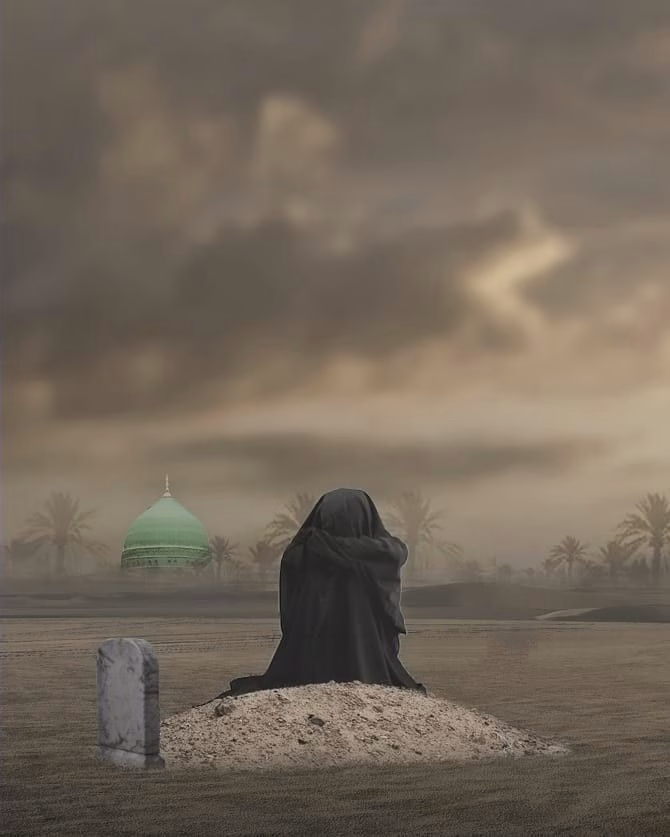
Most bereavement frameworks assume a temporal structure: there is a loss event, a period of acute grief, and (in healthy grief trajectories) an eventual integration. Even in prolonged grief, the loss event is located in the past. What distinguishes the grief of Baqīʿ is that the loss is not located in the past. The graves still stand demolished. The denial of access persists. The absence of markers, of domes, of any acknowledgment of what lies beneath the ground is not a historical fact; it is a present reality that is encountered anew by every Zawār who visits Medina.
The current state of Jannatul Baqīʿ has been described by visiting Zawār in terms that are consistent with a traumatic encounter: a flat, unmarked field of dirt and rubble, with no indication that four Imāms (ʿa) are buried there. Visiting hours are limited. Women are denied entry entirely. Lines move rapidly, with guards ensuring that visitors do not linger. Photography is prohibited. The experience of visiting Baqīʿ today has been described not as a completion of grief but as a re-opening of it. One does not visit the graves; one visits their absence.
Each year on 8 Shawwāl, the wound is both commemorated and re-inflicted. The commemoration of Yawmul Ghamm is not merely a remembrance of a past event. It is a confrontation with a present injustice. The graves are still demolished. The structures have not been rebuilt. The community still lacks the power to change this. The grief is, in a clinical sense, perpetual.
Kaya et al. (2024) found that disrupting Islamic mourning rituals measurably worsened grief outcomes in a Turkish-Muslim population during COVID-19 lockdowns. Their findings confirm what I posit is intuitive: that Islamic ritual practice around death and mourning is not decorative but functional; it serves a specific psychological role in processing loss. The destruction of Baqīʿ permanently disrupted the ritual practice of ziyārah. Zawār can no longer stand before a ḍarīḥ (shrine enclosure), no longer touch the walls of the structure, no longer perform the full embodied ritual of visiting the graves as it was practiced for centuries. This is not a temporary disruption. It is a permanent one, and based on Kaya and colleagues’ findings, its psychological cost should not be underestimated.
The Shīʿah tradition, once again, offers its own framework for understanding this ongoing grief. A narration attributed to Imām aṣ-Ṣādiq (ʿa) states:
“Allah has appointed to the grave of Imām Ḥusayn (ʿa), four thousand anguished and grief-stricken angels, who weep over him up to the Day of Judgment.”³
This ḥadīth, while referring specifically to the grave of Imām Ḥusayn (ʿa) in Karbalāʾ, establishes a theological principle that applies to all the Maʿṣūmīn (ʿa): grief for the Imāms (ʿa) is not a temporary state to be resolved. It persists until the Day of Judgment. It is held not only by human beings but by angelic beings appointed by Allah (swt) for this very purpose. The graves may be demolished on the physical plane, but they persist on the spiritual plane. The grief may be disenfranchised in the social world, but it is recognized, validated, and sanctified in the divine order.
Imām ʿAlī (ʿa) himself articulated the nature of prolonged sacred grief:
“The cheerfulness of a believer is in his face, and his sorrow is in his heart … His grief is long, his sorrow is distant, his silence is much, and his time is occupied …”⁴
The phrase “his grief is long” (ṭawīlun ghammuhu) is not a description of pathology. It is a description of spiritual depth. The believer’s grief is long because the injustice it responds to has not been resolved, because the moral wound has not been healed, because the graves have not been rebuilt.
Clinical Implications: What This Means for Clinicians
Having traced the grief of Baqīʿ through three overlapping frameworks (disenfranchised grief, moral injury, and ongoing desecration), I now turn to the question of clinical application. The preceding modules have established that this grief is socially unrecognized (Module 1), constitutes a wound to the moral universe (Module 2), and is continuously re-activated by present conditions (Module 3). What follows is an attempt to translate these frameworks into practical guidance for clinicians who encounter this grief in the consulting room.
For clinicians working with Shīʿah Muslim clients, the frameworks presented in this post have direct practical relevance. Based on my limited exploration, I offer the following considerations.
Recognize the grief as legitimate and clinically significant. The grief over Baqīʿ is not “just religious sentiment.” It meets established clinical criteria for disenfranchised grief (Doka, 1989; Corr, 1999) and moral injury (Litz et al., 2009). It has a structural basis (the ongoing demolition and denial of access), a social basis (the disenfranchisement of Shīʿah mourning practices), and a moral basis (the desecration of the sacred). Dismissing it as overly emotional or theologically eccentric is itself an act of disenfranchisement.
Do not pathologize communal sacred grief. This grief may present in clinical settings as: unresolved sadness around religious observances (particularly during Shawwāl and Muḥarram), anger at perceived injustice, spiritual distress, or a pervasive sense of moral injury. It is not, in itself, “complicated grief disorder” or “prolonged grief disorder” requiring clinical intervention. It is a communally held sacred grief that serves to define identity, confer meaning, and fulfill spiritual functions. Pathologizing it risks reproducing the very disenfranchisement that Doka described.
Know when to be concerned. The line between sacred grief and clinical distress is not always clear, but certain markers warrant attention: when the grief becomes isolating rather than communal (the person withdraws from majālis and community rather than finding solace in them), when it impairs daily functioning year-round (not only during observance periods), and when it triggers existential despair without hope (the theological framing of patience, divine justice, and ultimate restoration is no longer accessible to the individual).
Validate the theological framing. The client’s tradition teaches that this grief is sacred, that it is tasbīḥ, that it persists among the angels until the Day of Judgment. Clinical humility requires respecting this framework rather than replacing it with a secular alternative. The role of the clinician is not to resolve sacred grief but to ensure that it is held in a way that is sustaining rather than destructive.
The following table summarizes the clinical orientation:
| Recognize | Do Not |
| This grief is legitimate and clinically significant | Pathologize prolonged communal mourning |
| Sacred site destruction constitutes moral injury | Reduce it to “religious sentiment” |
| The tradition sacralizes grief itself | Impose secular grief timelines |
| Communal commemoration is adaptive | Discourage religious mourning practices |
This series is educational in nature and does not constitute clinical advice. Anyone experiencing distress related to grief, moral injury, or spiritual suffering should consult a qualified mental health professional.
Conclusion: Three Frameworks, One Truth
Three clinical frameworks converge to name what the Shīʿah community has always known. The grief of Baqīʿ is disenfranchised grief: a grief that the social world refuses to acknowledge, whose mourners are not recognized, and whose modes of mourning are stigmatized. It is moral injury: a wound to the moral universe, a transgression against the deeply held belief that sacred spaces deserve protection and sacred persons deserve dignity. And it is an ongoing wound: a grief that is not historical but present, re-activated with every visit to the unmarked field, re-opened with every annual commemoration.
The grief of Baqīʿ is not a failure to “move on.” It is a refusal to accept that the demolition of the graves of the Prophet’s family is a settled matter. It is a moral stance, a spiritual practice, and a communal bond. Doka gives it a clinical name. Litz and Pargament give it a psychological mechanism. The tradition of the Ahlul Bayt (ʿa) gives it a sacred status.
But if the graves are demolished and access is denied, what does one do with this grief? The next post in this series explores a question that is simultaneously clinical and theological: what happens when you cannot visit? And what does the tradition offer when the physical site of mourning has been taken away?
At Kisa Therapy Clinic, we believe that culturally responsive grief work requires understanding the specific contours of each community’s loss. The grief of Yawmul Ghamm is not a curiosity or a footnote. It is a living, communally held, theologically grounded form of suffering that deserves clinical recognition, scholarly attention, and, above all, respect.
Ali Raza Hasan Ali, MSW, RSW, Clinical Director, Kisa Therapy Clinic
References
Amin, R. (2025). Religious coping and moral injury among Muslim clinicians. Journal of Religion and Health.
Baker, J. E., et al. (2021). Disenfranchised grief and families’ experiences. Omega: Journal of Death and Dying, 83(1).
Bibi, S. (2025). Grief interrupted: British Muslim communities and COVID-19 disruption of Islamic burial rituals. SAGE Open.
Cameron, J. (2025). Healing through validation: The restorative role of social recognition in disenfranchised grief. Bereavement Care.
Corr, C. A. (1999). Enhancing the concept of disenfranchised grief. Omega: Journal of Death and Dying, 38(1), 1–20.
Doka, K. J. (1989). Disenfranchised grief: Recognizing hidden sorrow. Lexington Books.
Kaya, C., et al. (2024). Bereavement during lockdown: Grief outcomes in a Turkish-Muslim population. Mental Health, Religion & Culture.
Litz, B. T., Stein, N., Delaney, E., Lebowitz, L., Nash, W. P., Silva, C., & Maguen, S. (2009). Moral injury and moral repair in war veterans: A preliminary model and intervention strategy. Clinical Psychology Review, 29(8), 695–706.
Mattson, R. E., VanderWeele, T. J., et al. (2025). Moral, religious, or spiritual problem: Expanding the DSM-5-TR Z code. Journal of Nervous and Mental Disease.
Pargament, K. I., Magyar, G. M., Benore, E., & Mahoney, A. (2005). Sacrilege: A study of sacred loss and desecration and their implications for health and well-being in a community sample. Journal for the Scientific Study of Religion, 44(1), 59–78.
Rutter, E. (1928). The Holy Cities of Arabia. G.P. Putnam’s Sons.
Primary Sources
¹ Rutter, E. (1928). The Holy Cities of Arabia, G.P. Putnam’s Sons.
² Shaykh al-Mufīd. Amālī al-Shaykh al-Mufīd, p. 338.
³ Ibn Qulawayh. Kāmil az-Ziyārah, p. 119.
⁴ ʿAbd al-Wāḥid al-Āmidī. Ghurar al-Ḥikam, Ḥadīth #911.
Tears that Build Chambers: ʿAzāʾ, Communal Mourning, and the Grief the Clinic Forgot How to Honor
Introduction: The Grief That Will Not Be Scheduled It is two in the morning, three years after the funeral, and you are crying again. And somewhere beneath the grief is a second, more corrosive feeling: the suspicion that something is wrong with you for still grieving...
Muwāsāt: The Therapy of Being-With — Presence, Co-Regulation, and the Night of ʿĀshūrāʾ
Introduction: When There Is Nothing to Fix There is a particular hour that brings people to my consulting room, even when they arrive at it during the day. It is the hour, often around two in the morning, when a person sits on the floor of a bathroom or at the edge of...

Rebuilding What Cannot Be Rebuilt: Post-Traumatic Growth and the Community of Remembrance
Part 3 of 3 | The Graves They Could Not Bury: Islamic Psychology of Sacred Grief on Yawmul Ghamm Introduction: Can a Community Grow from a Wound That Remains Open? In the first post of this series, I named the grief: disenfranchised, morally injurious, and ongoing....